Open the LongHorn Steakhouse menu and the steak section can look simple until you have to choose between a filet, sirloin, ribeye, New York strip, T-bone and porterhouse.
They are all beef, but they do not eat the same. Some cuts emphasize tenderness. Others have more marbling and a richer beef flavor. The portion sizes also vary substantially. LongHorn’s published nutrition guide ranges from a 6-ounce Renegade Sirloin at 320 calories to the 22-ounce LongHorn Porterhouse at 1,280 calories.
LongHorn says its steaks are fresh rather than frozen and custom trimmed. The company also says its beef is aged for more than 20 days, with bone-in cuts fire-grilled and boneless cuts seared. Those are LongHorn’s own descriptions of its preparation process. The restaurant’s official signature steaks guide is useful if you want to compare its descriptions before visiting.
LongHorn steak comparison at a glance
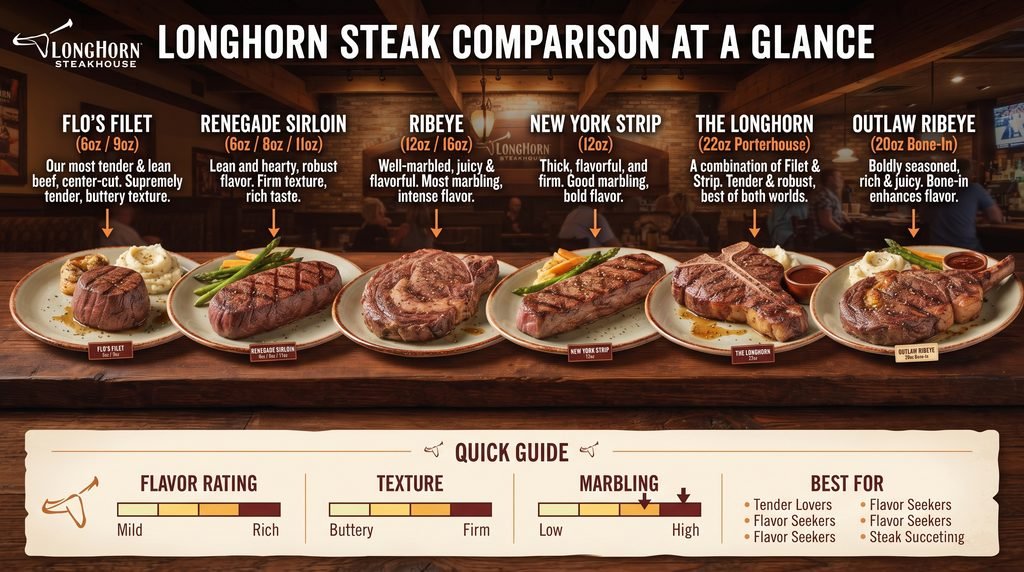
The calorie figures below come from the nutrition guide linked by LongHorn’s website. The downloadable guide itself carries a June 10, 2024 validity date, so current availability and recipes should always be checked before ordering.
| Steak | Listed size | Calories | Protein |
| Renegade Sirloin | 6 oz. | 320 | 36 g |
| Flo’s Filet | 6 oz. | 330 | 37 g |
| Renegade Sirloin | 8 oz. | 390 | 51 g |
| Flo’s Filet | 9 oz. | 450 | 56 g |
| New York Strip | 12 oz. | 630 | 72 g |
| Ribeye | 12 oz. | 810 | 66 g |
| Fire-Grilled T-Bone | 18 oz. | 1,130 | 123 g |
| Outlaw Ribeye | 20 oz. | 1,250 | 94 g |
| LongHorn Porterhouse | 22 oz. | 1,280 | 150 g |
These numbers cover the listed steak. Side dishes, salads, sauces, toppings and drinks can change the total meal considerably.
Flo’s Filet: the tenderness-focused choice
Flo’s Filet is LongHorn’s center-cut filet. LongHorn describes it as fresh, never frozen, and says the cut has been on the menu since the restaurant’s early days.
Filet comes from a part of the animal that does relatively little work, which is why filet is associated with a soft texture. It usually has less visible marbling than a ribeye.
On LongHorn’s nutrition guide, the 6-ounce Flo’s Filet has 330 calories and 37 grams of protein. The 9-ounce version has 450 calories and 56 grams of protein.
The portion sizes also make it easier to build a moderate meal around filet. A 6-ounce filet with steamed broccoli, for example, works out to about 420 calories using the restaurant’s published figures before other additions.
Choose filet when tenderness and a smaller steak portion matter more to you than heavy marbling.
Renegade Sirloin: leaner and more straightforward
LongHorn’s Renegade Sirloin comes in 6-ounce and 8-ounce portions in the published nutrition guide.
The 6-ounce steak is 320 calories with 36 grams of protein. The 8-ounce steak is 390 calories with 51 grams of protein. That makes sirloin useful for someone who wants a traditional steak dinner without jumping immediately to a 12, 18 or 20-ounce cut.
Sirloin generally has a firmer bite than filet and less marbling than ribeye. The tradeoff is that you get a recognizable beef texture and substantial protein in a relatively modest portion. If calories are part of your decision, the 6-ounce sirloin is the lowest-calorie traditional steak in the LongHorn nutrition figures discussed here.
Ribeye: more marbling and a richer texture
Ribeye takes the menu in another direction. Marbling is the fat distributed through the muscle. As the steak cooks, that fat affects both flavor and texture. This is one reason ribeye tends to feel richer than sirloin or filet.
LongHorn’s regular 12-ounce Ribeye is listed at 810 calories and 66 grams of protein. The difference between that and a 6-ounce sirloin is large enough that portion size should be part of the choice, not simply the name of the cut.
If you prefer a richer steak and do not mind a larger calorie total, ribeye is built for that style of meal.
Outlaw Ribeye: the larger bone-in ribeye
The Outlaw Ribeye is one of LongHorn’s signature steaks. LongHorn describes it as a 20-ounce bone-in ribeye with rich marbling, its proprietary seasoning and fire-grilled preparation.
The official nutrition guide lists the Outlaw Ribeye at 1,250 calories with 94 grams of protein. It is therefore a very different order from a 6-ounce filet or sirloin.
Someone choosing the Outlaw is usually choosing the large portion, bone-in format, marbling and fire-grilled style as part of the experience. If you simply want steak without such a large serving, the regular Ribeye, sirloin or filet gives you other routes.
New York Strip: firmer steakhouse texture
The New York Strip sits between the tenderness of a filet and the heavily marbled character of a ribeye. LongHorn calls the New York Strip a steakhouse classic and includes it among its signature cuts.
The nutrition guide lists the 12-ounce New York Strip at 630 calories and 72 grams of protein. A strip steak usually has more chew and structure than filet. For diners who like a substantial beef texture but do not want the same amount of marbling found in a ribeye, that difference can make the strip appealing.
LongHorn also mentions its 7-pepper seasoning as an option for the New York Strip on its signature steaks page.
Fire-Grilled T-Bone: two steak textures around one bone
A T-bone gives you two sections of beef separated by the bone. LongHorn describes its Fire-Grilled T-Bone as an 18-ounce bone-in steak combining strip flavor with filet tenderness.
The published nutrition information lists it at 1,130 calories and 123 grams of protein. That combination of two textures is the main reason to order a T-bone rather than treating it as simply another large steak.
It is also a substantial portion, so the choice of side matters. Pairing it with a 90-calorie broccoli side produces a very different overall meal from adding a 610-calorie Steakhouse Mac & Cheese.
LongHorn Porterhouse: the largest signature cut in this comparison
LongHorn’s Porterhouse carries the restaurant’s name and is one of the original cuts featured in its steak lineup, according to the company.
The nutrition guide lists The LongHorn at 22 ounces, 1,280 calories and 150 grams of protein. Like a T-bone, a porterhouse contains both strip and tenderloin sections. A porterhouse generally contains a larger tenderloin section than a T-bone.
For one diner, 22 ounces is a very large steak. The point of choosing it is quite different from ordering a 6-ounce filet. Portion preference should be considered before comparing anything else.
Which LongHorn steak fits what you are looking for?
If tenderness comes first, start your comparison with Flo’s Filet. If you prefer a leaner, firmer steak in a smaller portion, look at the Renegade Sirloin. If marbling and richness matter most, compare the Ribeye and Outlaw Ribeye.
If you prefer a firmer steakhouse bite, the New York Strip is the obvious cut to compare. If you like having both strip and tenderloin meat on the same bone, look at the T-Bone or Porterhouse. The porterhouse is the larger option in LongHorn’s published lineup.
There is no need to force all of these steaks into one “best steak” ranking. They suit different preferences.
Do not compare the steaks without comparing portion sizes
One mistake in steak comparisons is looking only at calories per menu item. The Outlaw Ribeye has 1,250 calories, while the 6-ounce Renegade Sirloin has 320. That does not mean ribeye somehow contains nearly four times as many calories in an equal serving. The Outlaw is also a 20-ounce steak while the sirloin is only 6 ounces.
Portion size, marbling and preparation all contribute to the final number. The same issue appears with protein. The 22-ounce Porterhouse contains 150 grams of protein, but it is also more than three times the weight of a 6-ounce steak.
Comparisons make more sense when the portion is visible beside the nutrition figure.
Your side can be almost as important as your steak
LongHorn lists Fresh Steamed Broccoli at 90 calories and Fresh Steamed Asparagus at 130. Fire-Grilled Corn is 200, Seasoned Rice Pilaf is 230 and a plain sweet potato is 240.
Steakhouse Mac & Cheese is listed at 610 calories and Seasoned French Fries at 500. This means someone ordering a smaller steak can still end up with a relatively large meal once sides and extras are included.
The opposite is also true. If the steak itself is the part of dinner you care about most, choosing a vegetable side can keep the rest of the plate simpler.
What about steak doneness?
LongHorn says its Grill Masters prepare steaks to the guest’s requested doneness. There is an important distinction between restaurant doneness terminology and food-safety guidance.
For home preparation, the USDA Food Safety and Inspection Service recommends that whole beef steaks, chops and roasts reach a minimum internal temperature of 145 F, or 62.8 C, followed by a rest of at least three minutes. Ground beef has a separate 160 F recommendation.
You can read the USDA safe minimum internal temperature guidance for the complete food-safety reference. It is useful because it separates personal doneness preference from the government’s minimum food-safety recommendation.
LongHorn prices depend on the restaurant
Avoid building your choice around an old menu PDF found in a search result. LongHorn’s own FAQ says menu prices may vary by location and asks customers to select their nearest restaurant when viewing the menu.
That matters for menu content too. A page that publishes one national “2026 price” without location context can become inaccurate quickly. It is better to explain cuts and sizes with sourced information and send readers to the local menu for the live price.
Final comparison
Flo’s Filet, Renegade Sirloin, Ribeye, Outlaw Ribeye, New York Strip, Fire-Grilled T-Bone and the LongHorn Porterhouse are not just differently named versions of the same steak.
The smaller filet and sirloin portions make sense when portion control matters. Ribeye puts more emphasis on marbling. Strip has a firmer steakhouse texture. T-bone and porterhouse combine two sections around the bone, while the Outlaw turns ribeye into a much larger bone-in order.
Once you know which texture and portion you want, choosing from the menu becomes much easier.
Frequently asked questions
What is the smallest LongHorn steak in this comparison?
The nutrition guide lists both the Renegade Sirloin and Flo’s Filet in 6-ounce portions.
How many calories are in the Outlaw Ribeye?
LongHorn’s published nutrition guide lists the 20-ounce Outlaw Ribeye at 1,250 calories.
What is the difference between Flo’s Filet and the Ribeye?
Flo’s Filet emphasizes tenderness and is sold in smaller portions. Ribeye has more marbling and a richer texture. LongHorn lists the 6-ounce filet at 330 calories and its 12-ounce Ribeye at 810 calories, although the serving sizes are not equal.
How big is LongHorn’s T-Bone?
The Fire-Grilled T-Bone is listed as an 18-ounce steak.
How big is the LongHorn Porterhouse?
LongHorn’s nutrition guide lists its namesake porterhouse at 22 ounces.
Are LongHorn Steakhouse prices the same everywhere?
LongHorn says prices may vary by location, so the local restaurant menu should be checked for current pricing.